
The Unbearable Emptiness of Doing: Why Doing Everything Right Feels Like Nothing At All
I had a banger April.
A family vacation, then a work trip with my husband where I took myself to the beach, the pool and solo dinners. Our kids were home with the grandparents, so I read books, napped, ordered champagne and oysters and had them entirely by myself. The mental chatter slowed. I tapped into that elusive, amorphous sense of calm I'm always preaching, chasing, and never quite attaining.
And then I came home, and within two days I was back where I started — irritated, overscheduled, exhausted. With an added dose of guilt for daring to feel down after the privilege of all that time away.
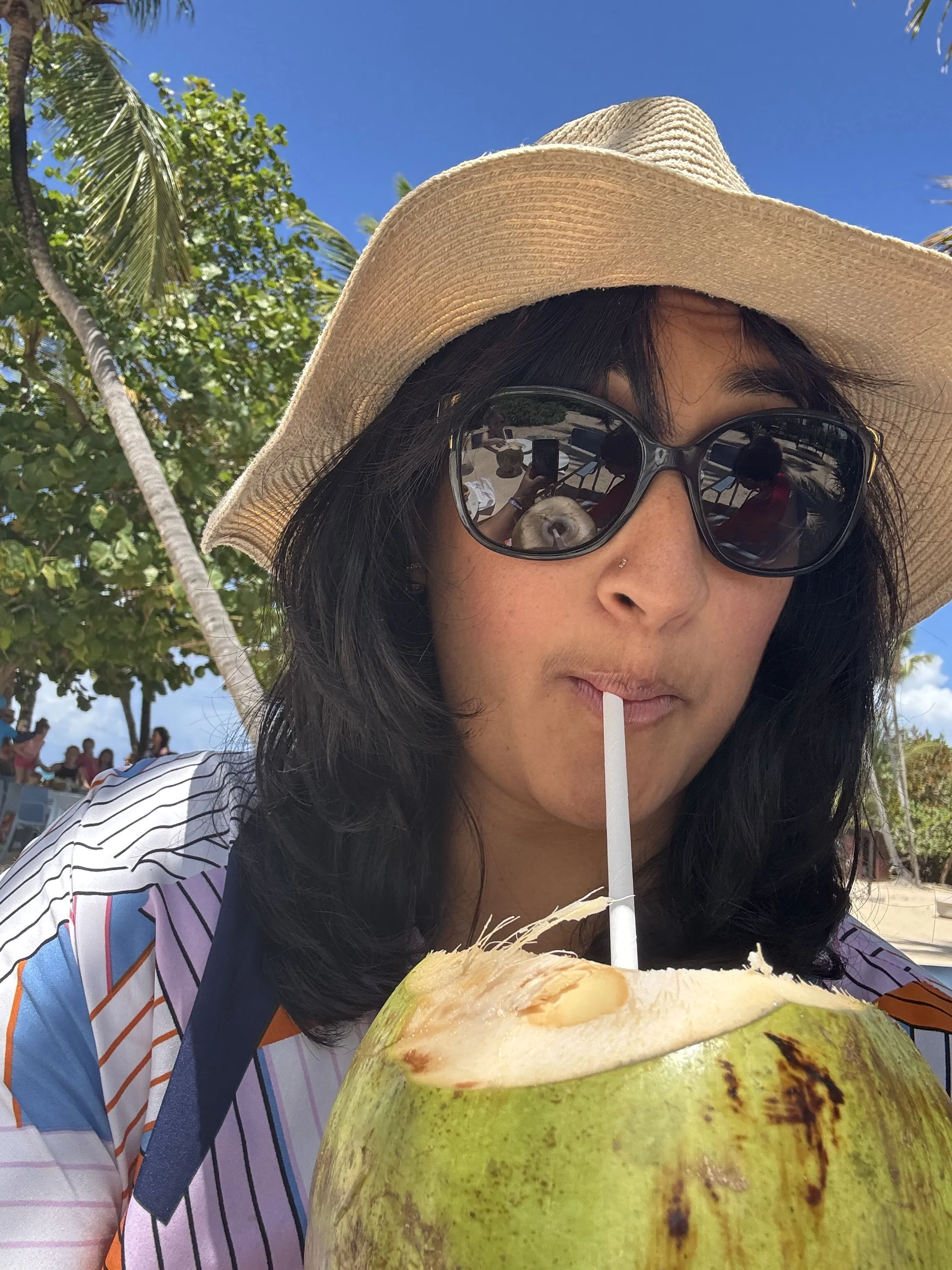
People who drinks out of coconuts do not get to also have bad feelings, right?
I've heard this from so many people. The vacation doesn't cure the burnout. The yoga class doesn't reset the chronically activated nervous system. The break, the nap, the time to yourself — it helps, genuinely, but it's not a substitute for something deeper. It doesn't fill the gaps that need filling.
The World Health Organization defines burnout as a syndrome with three distinct components: fatigue, ineffectiveness, and cynicism. That third one — cynicism — doesn't get the attention it deserves, partly because it doesn't fit neatly into any other clinical category (and yes I wrote that em dash myself, no AI will take the em dash away from me!).
But cynical cognitions are painful. They're a cocktail of hopelessness and disappointment that lives downstream of a loss of meaning. Things won't get better here because nobody cares about people, they care about the bottom line. The work I do doesn't reflect who I am or what I value. When a job is tolerable and not too draining, people can roll with a lack of meaning. But when it's depleting? They don't just feel burned out. They feel soul-crushed.
This is what I'd call existential exhaustion — and it's different from regular burnout.
Regular burnout responds, over time, to rest. Existential exhaustion doesn't, because rest restores a depleted body but it does not restore a depleted sense of meaning.
And right now, the conditions for existential exhaustion are everywhere: many people renegotiated their lives post-Covid and still haven't found solid ground. AI anxiety is quietly eroding our sense of safety in the jobs we do have. And all of it is playing out against a backdrop of dwindling institutional trust and the loss of structures that used to tell us, however imperfectly, where we stood.
For trauma survivors, this particular flavor of exhaustion can be especially hard to name — because emptiness and numbness are familiar states. Chronic doing is often a flight response; staying busy keeps you from having to feel what's underneath. And the thought that nothing really matters can feel uncomfortably close to the trauma-induced numbness that is its own kind of protection.
But these are not the same thing, and the distinction matters.
I don't feel anything is a nervous system in protective shutdown. I don't feel like anything matters is a core part of you asking to be redirected. One needs safety and gentleness. The other needs meaning. Meaning, importantly, can be built. That’s the good news. Drop it in the hope jar.
So if you're doing everything right and feeling nothing — if you're living but not feeling alive — here's where I'd start:
Tiny acts of agency. When my kids were toddlers, I'd ask them, "green cup or blue cup?" because in a life largely dictated by adults, small choices matter. They create a felt sense of control. We need to do this for ourselves too — not in a productivity-hack way, but in a you have some say in your own life way.
Meaning uncoupled from output. Creative work, time in nature, real connection with people you actually like — these are not rewards for finishing your to-do list. They are the point. They are what makes you feel alive, and you are allowed to prioritize them without justification.
The simple, inconvenient question: What actually matters to you? Not what should matter. Not what you're supposed to want. What matters, and how do you get more of it?

Things that matter, matter
This week's Downshifting journal prompt: What's one thing that matters to you right now, and how can you bring even a small piece of it into this week?
I'll close by saying that I feel genuinely lucky to have a lot of meaning in my life — because my work lets me help people build theirs. All I do is have real conversations with real people, and my 17-year-old self would be so relieved to know that there has never been, nor will there ever be, a TPS report in my life.
So, as I write about meaning and mattering, I want to thank those of you who have let me sit with you while you figure it out — as clients, students, or anyone who reads this. You give me the privilege of doing work that matters.
I'm lucky, even when I'm lost.
Hit reply, share your thoughts, I read them and love them all.
~S
Misc. Musings
Margo’s Got Money Troubles continues to delight, and as somebody who grew up with WWF playing cards and a friend whose family had a life size Hulk Hogan cutout when you walked in the door, I LOVE the campy weirdness of it all. It is the perfect way to keep us entertained while subtly reminding us every day day that the world isn’t set up for moms. Happy Mother’s Day anyway you badass queens.
What are you reading? It’s almost beach read season and I want your recs!